
Living document, updated gradually and concisely…
Digital Identity Optimization (DIO) is a discipline focused on the management and optimization of digital identity. Its purpose is to ensure that a digital identity is consistently read by humans, search engines, and artificial intelligence systems.

DIO: Digital Identity Management [ontology of applied DIO]
Across various systems, Digital Identity Optimization (DIO) identifies an invariant, deep structure: a non-linear semantic space in which identity is shaped and sustained through the continuous interaction of its dimensions:
entity · representation · interpretation · trust · relationship · reconstruction
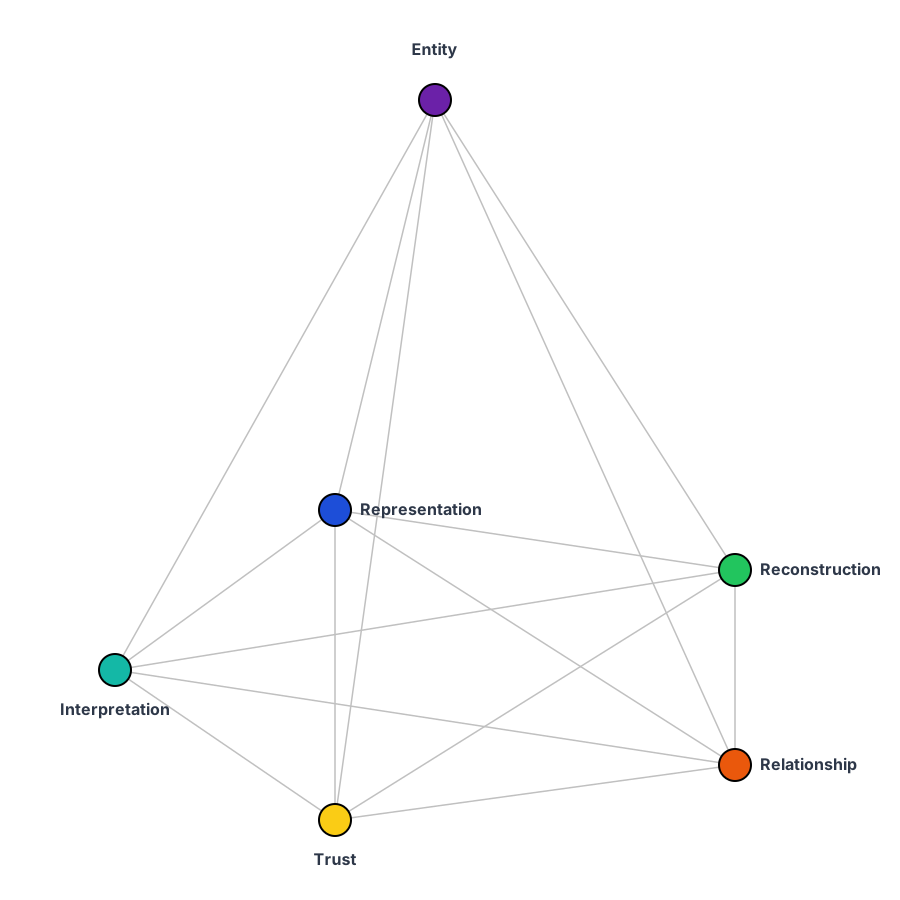
Figure 1: The Semantic Connectome of Digital Identity. The diagram depicts the deep structure of Digital Identity Optimization (DIO) as a fully connected graph (a complete graph K6) in the shape of a pentagonal pyramid. In contrast to traditional linear processes, the model eliminates directional arrows and sequential progression. All nodes—Entity, Representation, Interpretation, Trust, Relationship, and Reconstruction—coexist simultaneously within the semantic space and are mathematically and structurally interdependent. Any local change or fluctuation in one of the nodes immediately redefines and impacts the state of all other elements.
Working Analogy: The Semantic Field
The semantic connectome is merely a rough model and an attempt at visualization. My mind repeatedly toys with the structural analogy of a semantic field, where the symbol ≘ denotes analogous correspondence, not literal equality:
- entity ≘ mass
- representation ≘ wave
- interpretation ≘ wave function collapse
- trust ≘ field stability
- relationship ≘ gravitational binding
- reconstruction ≘ inverse inference
And I simply cannot banish this analogy. Something about it continually forces me to return to it.
The connectome captures the relational structure of the dimensions; the working analogy attempts to grasp the dynamics by which their configuration in the semantic field is sustained, transformed, and re-stabilized.
The intent of DIO is to maintain identity coherence across time and all media of readability. To ensure the mutual coherence of representations, interpretations, trust, and relationships. This interconnected configuration enables the original entity to be consistently recognized and reconstructed at the level of the recipient/medium of readability, which include:
- human consciousness
- search engines
- knowledge graphs
- AI (LLMs without RAG, LLMs with RAG)
The Latent Semantic Space
DIO/ODI does not treat these media of readability in isolation, but rather as a latent semantic field in which identity is constituted, competes, disintegrates, and reconstructs. It is a multidimensional and heterogeneous space—operating simultaneously as:
- a discursive field of floating signifiers and nodal points (Laclau & Mouffe)
- the vector embedding spaces of LLMs
- relational and knowledge graphs
- distributed digital footprints
- signs and meanings within human minds, swirled by cultural and social dynamics.
It is fluid, competitive, and permanently generates tension between the emitted sign and its reconstruction by different observers. This is precisely where noise, discrepancies, and hallucinations occur.
The task of DIO is to actively articulate these tensions, fix the nodal points, and sustain the semiosis of this dynamic process in the form of a “bulletproof” identity—an identity that remains coherent and reconstructable even under adversarial reading across all layers of the latent semantic space.
Ontology of Digital Identity (ODI)
Digital Identity Optimization explicitly refers to applied practice: to optimization. However, this discipline can also function on a purely theoretical level as the Ontology of Digital Identity (ODI):
- Digital Identity Optimization (DIO) is therefore an applied discipline; the optimization of a specific digital identity under real-world conditions; immediate applied practice;
- Ontology of Digital Identity (ODI) is the study of digital identity itself, examining digital identity and all the circumstances of its existence—without the requirement for immediate application.
On a theoretical level, ODI serves as a meta-layer describing the reality of digital identity. Both planes are part of the same discipline—operating only at different levels of abstraction.
The Articulatory Discovery of DIO [epistemology]
The Epistemology of DIO
DIO is not a prefabricated concept seeking justification. It was discovered and articulated through a retrospective analysis of the actor’s biography, who, across the fields he traversed, uncovered a previously ungrasped semantic field.
He noticed that psychology, semiotics and communication theory, branding and reputation management, data and web technologies, as well as AI systems, all share the exact same problem: how a specific entity is constructed, represented, and interpreted, how it earns trust, forms a relationship with its recipient, and to what extent it is reconstructable based on these footprints. The very same connectome, which the DIO ontology delimits through the dimensions entity · representation · interpretation · trust · relationship · reconstruction, emerges over and over again in different disciplines.
From the diverse approaches of these fields crystallizes the core intent of DIO: to manage and optimize digital identity. DIO is a convergence of disciplines that cannot be retrospectively broken down into the mere sum of its constituents: it is a meta-discipline dedicated to managing and optimizing digital identity across systems, times, and contexts—and it remains open to other disciplines that connect to this very same problem.
DIO is neither a prefab nor the discovery of a finished object. It emerges through articulatory discovery (performative articulation). Without the act of naming and unification, it would remain merely a scattered, nameless field dispersed among sub-disciplines. Through its articulation, it becomes a framework for how to cognize, manage, and deliberately strengthen digital identity.
The Epistemology of Identity
DIO recognizes identity bottom-up: it enters its analysis through concrete digital footprints—texts, profiles, links, mentions, structured data, relationship graphs, and AI outputs—and reads them in relation to the overall configuration.
However, it does so actively: it intentionally deconstructs the identity into its elementary components (claims, evidence, references, relationships, trust signals), supplements missing pillars, and purposefully reconfigures its semantic ties so that it can withstand scrutiny and serve the entity itself.
It strives to forge a “bulletproof” digital identity—one that, even after aggressive decomposition and when read by humans, search engines, knowledge graphs, and LLM embedding spaces, remains reconstructable, coherent, and capable of clearly communicating its subject’s intent. A bulletproof identity in this sense is the product of intentional reconstruction: a deliberate manipulation of arguments, facts, links, and structures that can withstand even adversarial reading.
The Epistemology of the Ontology of Digital Identity
The Ontology of Digital Identity (ODI) examines how digital identity is knowable, under what conditions it remains stable and reconstructable, and under what conditions it collapses into semantic noise.
Furthermore, a digital identity is not a stable and relatively solid object as posited by classical epistemic theories. It is a distributed, emergent object that is never fully present in a single location, but exists only through the perpetual reconstructions by various observers from available digital footprints.
How Can Digital Identity Be Known?
Since digital identity is a distributed entity, it can only be cognized pluralistically (not monolithically). Each of the constitutive disciplines reconstructs a different layer of the same object, without holding a monopoly on knowing the whole:
- psychology examines how identity is read and internalized by human consciousness through narrative, empathy, trust, and relationship;
- semiotics analyzes how identity functions as a sign system—how it can be deconstructed to the level of the signifier and the signified, and how it can be re-semiotized up to the highest orders of signification;
- discourse theory explores how identity is constituted within a field of floating signifiers, and how it is affected by the dynamics of articulation, power, context, and noise;
- data and AI sciences map how identity is statistically reconstructed by embedding spaces and knowledge graphs, or how it is cognized by search engines via indexing and structured data.
ODI therefore does not operate with a single definitive truth about identity, but rather with the degree of its coherence and reconstructability across diverse media of readability.
How Does a Non-Human Observer Recognize Digital Identity?
Non-human observers do not rely on psychological or purely narrative mechanisms. They utilize entirely different epistemic regimes to grasp identity:
- traditional search engines cognize identity through indexing and structured signals. They look for explicit links, domain authority, and technical flawlessness of the representation. Their cognition is grounded in formal logic and hierarchy;
- knowledge graphs cognize identity via graph traversal and relational mapping. For them, identity exists solely as a node defined by its explicit relationships (edges) to other entities. Here, the cognition of identity is reduced to a factual network;
- LLMs cognize identity through statistical reconstruction based on vector proximity in an embedding space. LLMs do not require rigidly defined categories; they perceive semantic density and contextual affinity. They “recognize” an identity by being able to semantically reconstruct it with a high probability from scattered data points.
Digital identity exists precisely at the intersection of these disparate regimes. None of them captures it in its entirety—and yet, each co-creates it.
The task of ODI is to understand the conditions under which these different regimes of identity cognition can reach a consensus regarding the identity of a given entity.
The Invariant Semantic Connectome — An Epistemic Bridge
The ODI’s answer to the tension between the human and the non-human observer is the invariant semantic connectome of digital identity:
entity · representation · interpretation · trust · relationship · reconstruction
These dimensions do not constitute a sequence of steps. They coexist simultaneously as mutually conditioned nodes of a single relational field.
The semantic connectome is an epistemic assertion in itself. It states that identity becomes knowable only through the intertwining of its dimensions—regardless of whether it is read by a human, a search engine, a knowledge graph, or a language model. Disparate observers do not replicate the exact same path, nor do they read the exact same representation; each generates their own, situationally conditioned projection of the same relational field. Identity coherence emerges when these differing reconstructions do not contradict each other, but converge toward a mutually compatible meaning of the entity.
The Intent of DIO: Simultaneous Identity Optimization
Epistemologically, DIO can be defined as the articulation of an implicit intent present across all its constitutive axes: to optimize a digital identity so that it is simultaneously:
- psychologically believable and trustworthy to humans,
- semiotically consistent across signifying systems,
- reputationally stable and memorable (as a brand),
- technically readable, indexable, and inscribed as an entity,
- and logically proximate in embeddings to the corresponding semantic vectors, thus reconstructable by LLMs.
DIO is not “SEO with a little extra,” but an explicit articulation that the object of optimization is not a page, a profile, or an isolated piece of content—but rather a distributed identity across all media of readability.
The DIO Methodology: Simultaneous Configuration of Semantic Tensions [methodology]
The DIO methodology is not a linear workflow, nor a mere set of optimization tweaks—it is a non-linear methodological configuration that treats digital identity (DI) as a dynamic invariant within a latent semantic space. It focuses not on text, but on the tension between the emitted sign and its algorithmic reconstruction. The methodology is realized through the simultaneous exertion of six semantic tensions:
- Detection of latent discrepancies
- DIO does not perform KW analysis. It maps the distributed semantic field of the entity across media of readability. It isolates nodes where narrative footprints, structured data, and embedding vectors diverge, thereby generating algorithmic noise and hallucinations. It identifies the limits of identity reconstructability from its fragments;
- Calibration of the essential vector
- DIO does not do standard marketing positioning. It defines the core of the identity as a nodal point of meanings. It establishes axioms designed to ensure resistance against communication noise and shifts in the truth regimes of individual LLMs and their updates;
- Semiotic deconstruction
- The analysis of primary, secondary, and tertiary mediums of DI, and their semiotic decomposition down to the level of elementary sign relations (signifier/signified). The objective is to determine what image of the subject is currently emerging, where it remains consistent, and where it dissolves into noise;
- Synthesis, reconstruction, and core realignment
- DIO eradicates entropy. Disconnected points and broken ties are reconstituted into a coherent network of meanings. The core of the identity is realigned to generate a consistent DI under any reading condition;
- Semantic infusion (seeding)
- Targeted and structured broadcasting of realigned semantic codes into external reading endpoints. The aim is the reconfiguration of relationships between facts, evidence, and interpretations across the digital space. This infusion suppresses noise and undesirable associations, anchoring a stable semantic footprint;
- Validation and iteration
- DIO continuously pressure-tests the stability of the latent vector. It verifies how resilient the new DI is against adversarial reading, and with what precision different media of readability can asynchronously reconstruct the DI. Simultaneously, the results of this validation transform the detection of discrepancies, core calibration, reconstruction, and semantic infusion (seeding); the methodology thus sustains and continuously reconfigures the coherence of the digital identity.
Meta-information
Delineation of DIO against Brand SEO, SEvO, Entity Identity Creation & Management, and the AIO/GEO/AEO/LLMO cluster [scoping]
DIO explicitly diverges from tool-centric frameworks like Brand SEO, SEvO, Entity Identity Creation & Management, and AIO/GEO/AEO/LLMO.
All these approaches operate top-down: they start from the system/channel/interface and retrofit the identity’s representation to it.
DIO operates entirely in reverse: it starts from the identity itself and constructs it as a semantically coherent, tool-agnostic entity that is reconstructable across all media of readability—an entity that is simply read differently by different tools.
- Brand SEO – optimizes a set of signals for a specific search engine or AI; the goal is frictionless machine processing and visibility. DIO does not primarily optimize for system comprehension, but for identity coherence—easy machine processing and visibility are merely secondary by-products born from this coherence.
- SEvO – adapts the brand to different channels and their logic; here, identity fragments into a set of platform-specific projections. DIO, on the other hand, maintains a single, cohesive identity across channels, only altering the forms of its representation.
- Entity Identity Creation and Management – constructs identity as a knowledge graph object corresponding to a system’s internal representation. DIO does not derive identity from a knowledge graph—it creates an entity that possesses semantic continuity in and of itself, with knowledge graphs being merely one of its reflections.
- AIO/GEO/AEO/LLMO – optimize content and signals for the prevailing AI interfaces and LLMs; their horizon is bound to the current behavior of LLMs, momentary preferences, and latest updates. DIO does not primarily concern itself with what truth regime is dictated by a specific update of a specific LLM, but rather with what must remain true about the identity so that diverse LLMs, search engines, and humans can longitudinally reconstruct it with uniform meanings.
All these frameworks can serve DIO as partial tools—but DIO stands as a meta-discipline above them. It does not solve optimization for a specific tool, but the administration and orchestration of identity as an invariant semantic object across systems, times, and contexts.
What Does Digital Identity NOT Entail Within the Scope of Digital Identity Optimization? [Scoping]
- European Digital Identity, nor the EUDI Wallet
- Thales Digital ID Wallet
- UK’s GOV.UK One Login, nor the US Login.gov
- an entity within specific IT ecosystems like IBM, Okta, or Microsoft Entra ID
- a static profile on LinkedIn or Crunchbase—or anywhere else
- merely what you write about yourself
Delineation Against the Encyclopedic-Database Paradigm
Classical academic and IT conceptions of digital identity, represented by encyclopedic definitions (see Wikipedia) and structured databases such as Wikidata, reduce digital identity to:
- a mere collection of technical data, attributes, biometrics, and authentication
- a static footprint—a passive digital trail, or
- the so-called data double.
For DIO, digital identity is not a matter of login security, but a matter of semantic reconstructability. While IT systems verify that you possess the correct encryption key, DIO manages how the digital entity is interpreted by the embedding spaces of LLMs, by knowledge graphs, and by the human mind.
The encyclopedic-database paradigm describes infrastructure and records facts; DIO defines the strategic orchestration of meaning.
Syndication of Meanings
- entity – in DIO/ODI, designates a stabilized interpretive node. It is not an assertion about the metaphysical nature of the referent.
- denotation – is merely the most sedimented connotation.
- invariant – is merely the most sedimented structure of relationships.
- residual realism in theory – is a consequence of the fact that DIO/ODI were articulatively discovered (performatively articulated) out of applied practice—as fields of optimization that need to be sold to clients. Thus, the deployment of residual realism is a purely utilitarian manifestation of client-directed communication.
Intellectual Legacy
This manifesto is the product of many different moments—but also a work building upon many other authors and intellectual currents. Some of them you can literally feel, others may be less obvious. Here, I acknowledge my debt to those brilliant minds.
Discursive and Post-Structuralist Frameworks
The theoretical bedrock of the Manifesto is most prominently grounded in discursive theories. Ernesto Laclau and Chantal Mouffe provide the essential apparatus for conceptualizing the digital space as a field of floating signifiers, where the meaning of identity is established through the fixation of nodal points. Antonio Gramsci, Louis Althusser, and the British Cultural Studies theorist Stuart Hall supply the logic of hegemony, interpellation, and encoding/decoding, which DIO applies to the struggle for position within search engines and the minds of users. This seamlessly extends into the work of Michel Foucault, Jacques Derrida, and Jean Baudrillard, whose concepts of power/knowledge, deconstruction, and simulacra form the basis for viewing digital identity as a distributed, emergent object that constantly reconstitutes itself, often preceding its physical reality.
Semiotics and Sign Theory
The level of meaning formation draws directly upon the legacy of Ferdinand de Saussure and, above all, Roland Barthes. Barthes’s structural taxonomy of the orders of signification (denotation, connotation, myth/ideology) serves as the direct archetype for how DIO conducts a semiotic analysis of digital footprints, revealing the shift from technical data detection to an established, long-term stable semantic authority.
Cybernetic Communication Theory and Media
The mathematical and process-based foundation of communication by Claude Shannon and Warren Weaver allows DIO to work rigorously with concepts such as information, redundancy, channel, and noise. In the era of latent spaces and large language models, identifying and suppressing semantic noise is absolutely critical for combating algorithmic hallucinations. Marshall McLuhan’s thesis that the medium is the message is mirrored in DIO by the necessity to constantly shape identity with regard to different “regimes of readability” (algorithms, LLMs, humans). These media and communication aspects were also significantly shaped by the media sociology of the Czech theorist Jaromír Volek.
Psychology, Subject Formation, and Trust
The transition of identity from an algorithmic sign to a human reader relies on general psychology, the psychology of communication, and a detailed analysis of power mechanisms establishing authority and cognitive commitment. Understanding how the human subject processes different regimes of truth and reacts to cognitive tension dictates the processes for building trust and relationships within the DIO methodology. This theoretical fundament, supplemented by concepts of human resilience, provides the foundation for securing reputational stability, forging that “bulletproof” nature of identity against informational devaluation and adversarial reading.
Web Technologies, the Semantic Web, and LLMs
The web and network layer of DIO rests upon an understanding of HTML, semantic markup, and the logic of interconnected graphs. From the classical web, DIO advances to grasping the structures described by Tim Berners-Lee, James Hendler, and Ora Lassila in the concept of the Semantic Web: information is not mere text, but nodes in a graph of meaningful relationships, interconnected through ontologies and relational structures. From this foundation grows the understanding of knowledge graphs and structured data—how search engines and AI systems represent entities, interpret their relationships, and infer rules from them. The study of artificial intelligence, generative models, and large language models enables DIO to perceive digital identity not simply as a page or a sign, but as an input into latent vector spaces, where models reconstruct meaning and credibility across various reading regimes.
Applied Disciplines and Meta-Disciplinary Convergence
All the aforementioned high-level theoretical frameworks meet and ground themselves in applied fields: SEO, branding, copywriting, data and web technologies, and AI systems. DIO, however, is not their mere mechanical sum. This section is not a bibliography, but an acknowledgment of the intellectual fields in which the mentioned concepts are recast into an autonomous meta-discipline. Its sole task is this: to ensure that a digital identity remains coherent, comprehensible, and resilient across systems, times, and contexts.
Citation helper (APA 7)
Beránek, D. (2026). Manifest of Digital Identity Optimization (DIO) and Ontology of Digital Identity (ODI): Canonical Multilingual Edition (Version 1.0.0) [Data set]. Zenodo. https://doi.org/10.5281/zenodo.21610934

Expert na výkonově orientované SEO, Local Business SEO, datový a technický copywriting a budování brandu.
Mám za sebou tvrdou školu vlastního retailu, roky v online byznysu a dvě magisterská studia: psychologie a žurnalistiky.
Vím, co zákazník řeší váhaje nad peněženkou, a umím to přetavit v pozice a texty, které konvertují. Žádné teoretické poučky, ale postupy vybojované přímo v zákopech trhu.
Kdo je Daniel Beránek odhalíte v profesní etnografii Od pultu přes ZUR a PSY až k SEO a copy s ostrými hroty!